










Category


sCMOS Camera
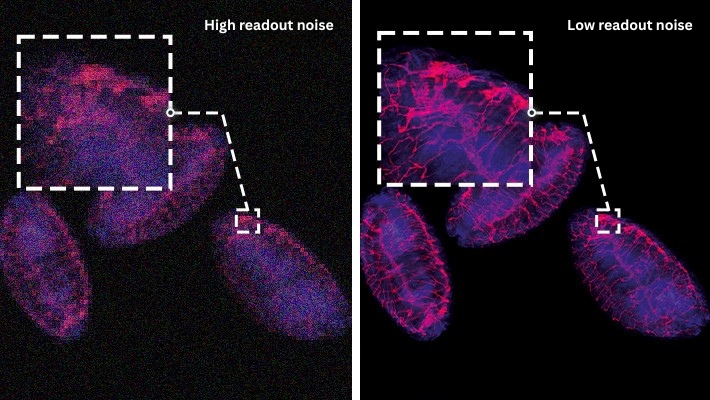
SinceVision provides high performance sCMOS cameras for low light imaging and advanced research. These scientific sCMOS cameras deliver up to 95% light collection efficiency, making them the ideal choice for biological microscopy, space observation, and quantum physics experiments.
Product Advantages

New product recommendations

Cases

Product Selection
| Model | Max. Resolution | Full Frame Rate (fps) | Quantum Efficiency | Cell Size (μm) | Readout Noise | Dark Current | Max. refrigeration temperature difference | Product Status | Compare | Favorites |
|---|---|---|---|---|---|---|---|---|---|---|
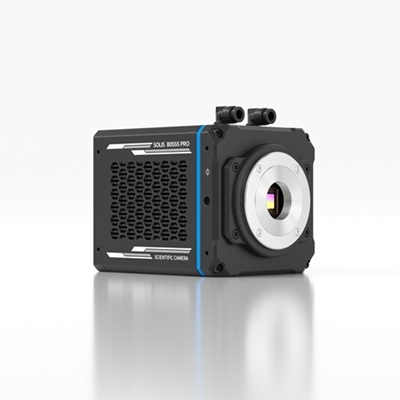
| Solis B0555 PRO | 2560x2048 | 240fps@Global,120fps@Rolling,45fps@USB3.1 | 95%@520nm | 5.5μm | 0.34e- (RMS) (Standard) 0.29e- (RMS) (Ultralow noise) | 0.002e-/pixel/s@-30℃;80e-/s @60℃ | 55℃ below ambient temperature @ water cooling | Published |
|

|
| Solis B518 | 800x600 | 120FPS | 89.5%@465nm | 18μm | 0.45e- (median);0.32e- RMS (Ultra-Low Noise Mode) | 0.007e-/pixel/s@-30℃ | 60℃ below ambient temperature @ water cooling | Published |
|
|
| Solis B0465 | 2048x2048 | 100FPS@10Gige,40FPS@USB | 95%@560nm | 6.5μm | 1.1e- (median) | 0.5e-/pixel/s@-10℃;0.08e-/pixel/s@-30℃ | 55℃ below ambient temperature @ water cooling | Published |
|
|
File
SinceVision-SG & SGI Series Documentation
ZIP / 4.43MB
Technical Guide
 Download Now
 Add to Download List
SinceVision-SGI080 Parameter
PDF / 167.54KB
Product Specifications
SinceVision-SG & SGI Series Documentation
ZIP / 4.43MB
Technical Guide
SinceVision-SGI080 Parameter
PDF / 167.54KB
Product Specifications
FAQs
-
1. What does sCMOS stand for?


sCMOS stands for Scientific Complementary Metal Oxide Semiconductor, designed specifically for scientific research needing precise signal measurement.
-
2. Can an sCMOS camera truly replace an EMCCD for single-photon imaging?
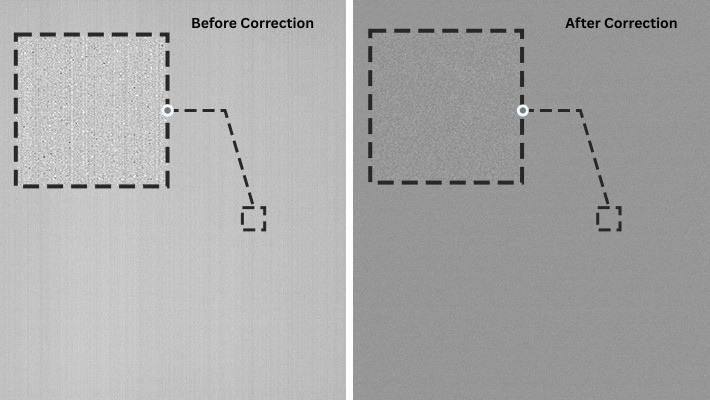
Traditionally, EMCCDs were the gold standard for ultra-low light because they could amplify signals above the readout noise. However, modern sCMOS cameras like the SinceVision Solis series have reduced readout noise to sub-electron levels (0.29e⁻). Because sCMOS sensors do not suffer from "multiplication noise" (a byproduct of the EMCCD amplification process), they often provide a higher Signal-to-Noise Ratio (SNR) once the light level exceeds a few photons per pixel. They also offer much higher speeds and resolutions than EMCCDs.
-
3. What is the benefit of "Back-Illuminated" (BI) technology in sCMOS?
In a standard CMOS sensor, the metal wiring is on the front, which reflects or absorbs some incoming light. Back-Illuminated technology flips the sensor so light hits the silicon directly from the back.
The Result: This increases the Quantum Efficiency (QE) to a peak of 95%. For researchers, this means nearly every photon that hits the sensor is converted into an electron, which is critical for faint signals in fluorescence microscopy or deep-space observation.
-
4. Why is "Vacuum Sealing" important for a scientific camera?
To reach the ultra-low noise levels required for scientific research, the sensor must be cooled (often to -40°C or lower). Without a specialized vacuum seal, three things happen:
1. Condensation: Moisture from the air would frost over the sensor.
2. Thermal Leakage: Air would transfer heat back to the sensor, making the cooling less efficient.
3. Longevity: A permanent vacuum (like SinceVision's technology) ensures the internal components do not degrade over years of deep-cycle cooling.
-
5. Should I use Rolling Shutter or Global Shutter for my experiment?
Most high-performance sCMOS cameras use a Rolling Shutter to achieve the lowest possible readout noise (e.g., 0.29e⁻).
1. Rolling Shutter: Best for static or slow-moving samples (e.g., cell imaging) where the priority is the lowest noise and highest frame rate.
2. Global Shutter: Best for high-speed "snapshot" imaging of fast-moving objects (e.g., combustion or particles) to avoid spatial distortion, though it typically comes with a higher noise floor.
Discover more







 Compare